

Julia Zalewska-Biziuk
During the ages of French Revolution Abbé Grégorie, French priest and revolutionist, demanded that the culture’s treasures, formerly belonged to riches, were given back to society. He invented the idea of “un héritage commun”. “In the sculptures, paintings and books is the sweat of the people – people’s property must be given back to them” he said. Society had legitimate by “sweat of the people” right to its cultural heritage. At the cost of private property.
Between 1967 and 1970 took place one ot the late 20th century’s bloodiest civil conflicts; Igbo, the third – after Hausa and Yoruba – biggest tribal group in Nigeria, fought with Nigerian state for the breakaway of their potential future country – The Republic of Biafra. Nigeria during that time combated separatists savagely since it occurred in the south-west part of the country, where the Biafra is located, were substantial amounts of oil.

The war claimed over million of the Igbo’s lives. The secessionists surrendered in 1970. In the meantime traders and smugglers seized the opportunity – as it is easier to steal when no one is watching and in the chaos caused by Biafran war no one really did. There are a good chances intermediates were engaged in illegal disposal as well.
So, the Igbo was robbed for years. They lost perhaps forever a huge part of their cultural legacy. Time passed and the works of their culture, which at first was the subject of illegal trading, entered the legal market. To this day one can come across these objects on luxury exhibitions all over the world and even bid them in the auction house; for a proper price. One of such auction houses, Christie’s, located in Paris, has experience in selling such things. Christie’s is renowned for selling luxury items to affluent collectors. Lately it sold for the record price of 2,115 million euro 28,89-carat diamond ring. Christie’s offers also carved plates from Yuan dynasty collection (1279-1368), 19th century paintings form India, tribal mask from Papua New Guinea or Igbo’s artefacts.
In 29th June the world witnessed another auction of the objects with obscure circumstances of removal from their place of origin. Christie’s announced an auction of two wooden sculptures made by Igbo community. Most likely they were were looted from communal shrines – but no one can really prove it. The figures, described by Christie’s as „among the greatest sculptures of African art” were sold to an online bidder for 212 500 euros to become the part of one’s private collection. Abbé Grégorie would turn in his grave.
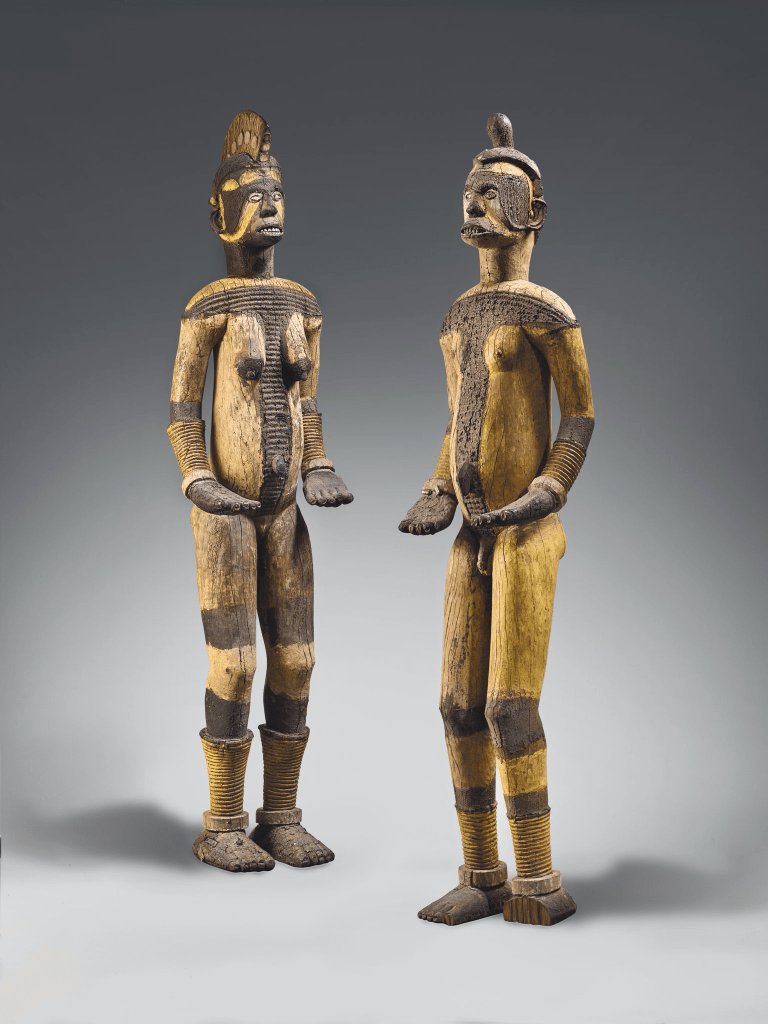
©CHRISTIE’S IMAGES LTD, 2020
Mr. Chika Okeke-Agulu, art historian from University of Princeton, said these sculptures are only a part of all looted artefacts from Igbo’s community.
Nigeria called on Christie’s to halt the sale. It emphasised on possible violation of The Hague Convention of 1954 adopted to protect cultural property in the event of armed conflict, which Nigeria joined in 1961, as well as of UNESCO Convention of 1970, which banned the international trade in stolen artefacts. Nevertheless, Christie’s declared that auction in 29th June is perfectly legal. “There is no evidence these statues were removed from their original location by someone who was not local to the area” Christie’s said in a statement before the auction. Bernard de Grunne, Belgian who sold the sculptures to the seller at Christie’s in 2010 stated that they “cannot connect them with the chaos caused by the Biafran war, as it is unknown when precisely they came out of Nigeria. They could have come out anytime between 1968 and 1983” – it is hard to speculate nowadays. Moreover, he said, we can consider these great works of art were saved for the world to admire. Otherwise these would have been probably destroyed in the civil war.
The auction house said the collector acquired them from an African dealer in 1968 or 1969, either in Cameroon or Paris, before they were later acquired by another private collector, who was the seller on Monday. There is one more thing. During the war many looted artefacts were the subject of smuggling across the Nigerian-Cameron border from where they were bought by traders and shipped to Europe.
Mr. Chika Okeke-Agulu comperes the problem with the times of repatriation of European artworks after II World War. Back then Europeans returned each other stolen cultural property; “Since Africa doesn’t matter politically it is all about business and profits”. Okeke-Agulu’s voice is one of many calling for the repatriation of African artworks in European and American collections that are thought to have been acquired through colonial exploitation or illegal looting; In 2018 president Macron promised the return of thousands of African artefacts located in French museums to be returned to the continent. „In the sculptures, paintings and books is the sweat of the people – people’s property must be given back to them” – Abbé Grégorie lived to see public museums, where every French can see the treasures of their cultures. Will African property be given back to its people too? As Kenneth Clark, British art historian and director of London National Gallery, said at the sight of Constable’s painting hanging on the wall in Yale, “legacy of your own means to us the most when we see someone else inherited it”.
 szkielkoioko.org